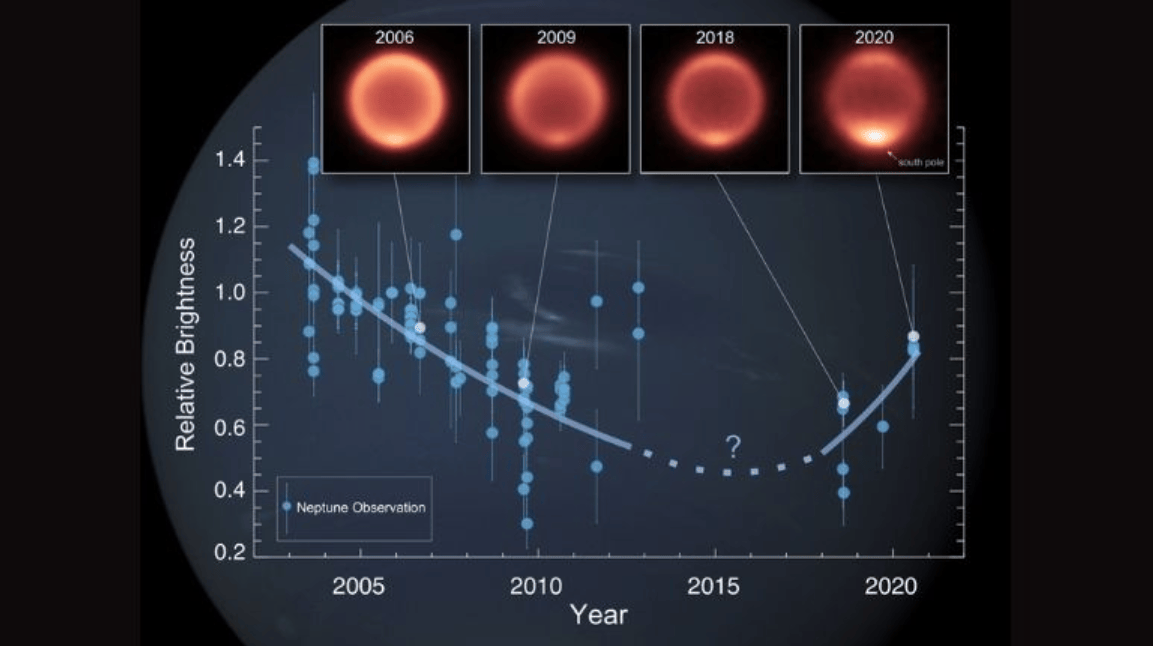
ENG: An international team of researchers, including scientists from Leicester and NASA’s Jet Propulsion Laboratory (JPL), combined all existing thermal infrared images of Neptune gathered from multiple observatories over almost two decades. These include the European Southern Observatory’s Very Large Telescope and Gemini South telescope in Chile, together with the Subaru Telescope, Keck Telescope, and the Gemini North telescope, all in Hawaii, and spectra from NASA’s Spitzer Space Telescope.
Credit: Michael Roman/NASA/JPL/Voyager-ISS/Justin Cowart
ENG: For 50 years, interplanetary probes have returned thousands of striking images of the surface of Mars, but never a single sound. Now, NASA’s Perseverance mission has put an end to this deafening silence by recording the first ever Martian sounds, which can be listened to here. The scientific team for the French-US SuperCam2 instrument installed on Perseverance was convinced that the study of the soundscape of Mars could advance our understanding of the planet. This scientific challenge led them to design a microphone dedicated to the exploration of Mars, at ISAE-SUPAERO in Toulouse, France. Perseverance first recorded sounds from the Red Planet on February 19, 2021, the day after its arrival. These sounds fall within the human audible spectrum, between 20 Hz and 20 kHz. First of all, they reveal that Mars is quiet, in fact so quiet that on several occasions the scientists thought the microphone was no longer working. It is obvious that, apart from the wind, natural sound sources are rare.
ENG: A team mapping radio waves in the universe has discovered something unusual that releases a giant burst of energy three times an hour, and it’s unlike anything astronomers have seen before. Spinning around in space, the strange object sends out a beam of radiation that crosses our line of sight, and for a minute in every twenty, is one of the brightest radio sources in the sky. The team who discovered it think it could be a neutron star or a white dwarf which are collapsed cores of stars with an ultra-powerful magnetic field.
ENG: NASA’s James Webb Space Telescope launched at 7:20 a.m. EST Saturday on an Ariane 5 rocket from Europe’s Spaceport in French Guiana, South America. A joint effort with ESA (European Space Agency) and the Canadian Space Agency, the Webb observatory is NASA’s revolutionary flagship mission to seek the light from the first galaxies in the early universe and to explore our own solar system, as well as planets orbiting other stars, called exoplanets.