ENG: Data collected by remote-sensing satellites is fundamental for many key activities, including aerial mapping, weather prediction, and monitoring deforestation. Currently, most satellites can only passively collect data, since they are not equipped to make decisions or detect changes. Instead, data has to be relayed to Earth to be processed, which typically takes several hours or even days. This limits the ability to identify and respond to rapidly emerging events, such as a natural disaster.
Credit: Sentinel-2 data (ESA) processed by Vít Růžička
ENG: In 2015, when NASA’s New Horizons spacecraft encountered the Pluto-Charon system, the Southwest Research Institute-led (SwRI) science team discovered interesting, geologically active objects instead of the inert icy orbs previously envisioned. An SwRI scientist has revisited the data to explore the source of cryovolcanic flows and an obvious belt of fractures on Pluto’s large moon Charon. These new models suggest that when the moon’s internal ocean froze, it may have formed the deep, elongated depressions along its girth but was less likely to lead to cryovolcanoes erupting with ice, water and other materials in its northern hemisphere.
Courtesy of NASA/Johns Hopkins University Applied Physics Laboratory/Southwest
RO: NASA’s James Webb Space Telescope has revealed the once-hidden features of the protostar within the dark cloud L1527, providing insight into the beginnings of a new star. These blazing clouds within the Taurus star-forming region are only visible in infrared light, making it an ideal target for Webb’s Near-Infrared Camera (NIRCam). The protostar itself is hidden from view within the “neck” of this hourglass shape. An edge-on protoplanetary disk is seen as a dark line across the middle of the neck. Light from the protostar leaks above and below this disk, illuminating cavities within the surrounding gas and dust. The region’s most prevalent features, the clouds colored blue and orange in this representative-color infrared image, outline cavities created as material shoots away from the protostar and collides with surrounding matter. The colors themselves are due to layers of dust between Webb and the clouds. The blue areas are where the dust is thinnest. The thicker the layer of dust, the less blue light is able to escape, creating pockets of orange.
Credits: NASA, ESA, CSA, and STScI. Image processing: J. DePasquale, A. Pagan, and A. Koekemoer (STScI)Read More
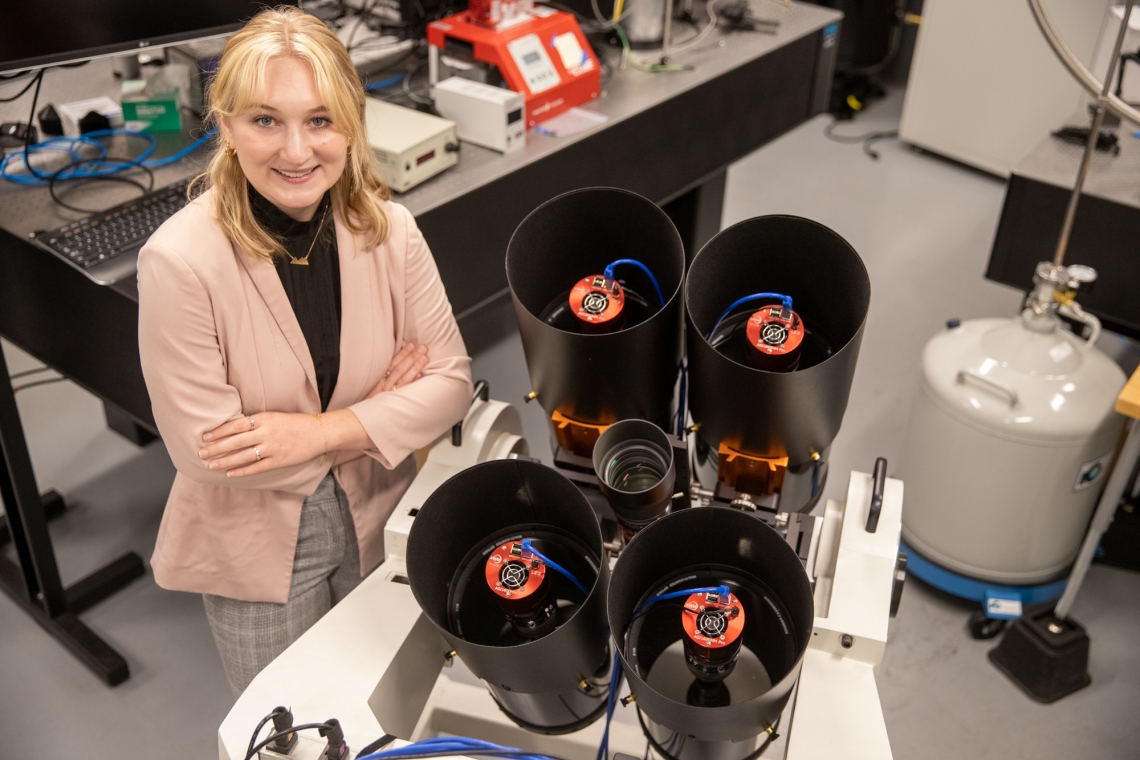
ENG: As satellites crawl across the sky, they reflect light from the sun back down to Earth, especially during the first few hours after sunset and the first few hours before sunrise. As more companies launch networks of satellites into low-Earth orbit, a clear view of the night sky is becoming rarer. Astronomers, in particular, are trying to find ways to adapt. With that in mind, a team of University of Arizona students and faculty completed a comprehensive study to track and characterize the brightness of satellites, using a ground-based sensor they developed to measure satellites’ brightness, speed and paths through the sky. Their work could be helpful for astronomers, who, if notified of incoming bright satellites, could close the shutters of their telescope-mounted cameras to prevent light trails from tainting their long-exposure astronomical images. The research team was led by professor of planetary sciences Vishnu Reddy, who also co-leads – with study co-author and professor of systems and industrial engineering Roberto Furfaro – the university’s Space Domain Awareness lab, which tracks and characterizes all kinds of objects orbiting Earth and the moon.
Grace Halferty, a senior graduating this summer with a bachelor’s degree in aerospace and mechanical engineering and the paper’s lead author, with the instrument researchers built to measure the brightness and position of SpaceX Starlink satellites. Credit: Kyle Mittan/University Communications