Today we take a look at the fundamental theory behind camera parameters to better understand how matrix multiplication is employed.
Video description: First Principles of Computer Vision is a lecture series presented by Shree Nayar who is faculty in the Computer Science Department, School of Engineering and Applied Sciences, Columbia University. Computer Vision is the enterprise of building machines that “see.” This series focuses on the physical and mathematical underpinnings of vision and has been designed for students, practitioners and enthusiasts who have no prior knowledge of computer vision.
In an ambitious promotional video, Virgin Hyperloop explains how it envisions its high-speed transportation system working in the future. Pods that will hold up to 28 passengers will travel at speeds surpassing 670 miles per hour — three times faster than high-speed rail and 10 times faster than traditional rail — using proprietary magnetic levitation and propulsion that guides the vehicles on the track. The pods will travel in convoys down the tube so they can head to different destinations. The company has made some bold claims, betting its system will be more sustainable, cost-effective and convenient than presently available modes of transportation, leaving many skeptical about whether the plans will ever come to fruition as promised.
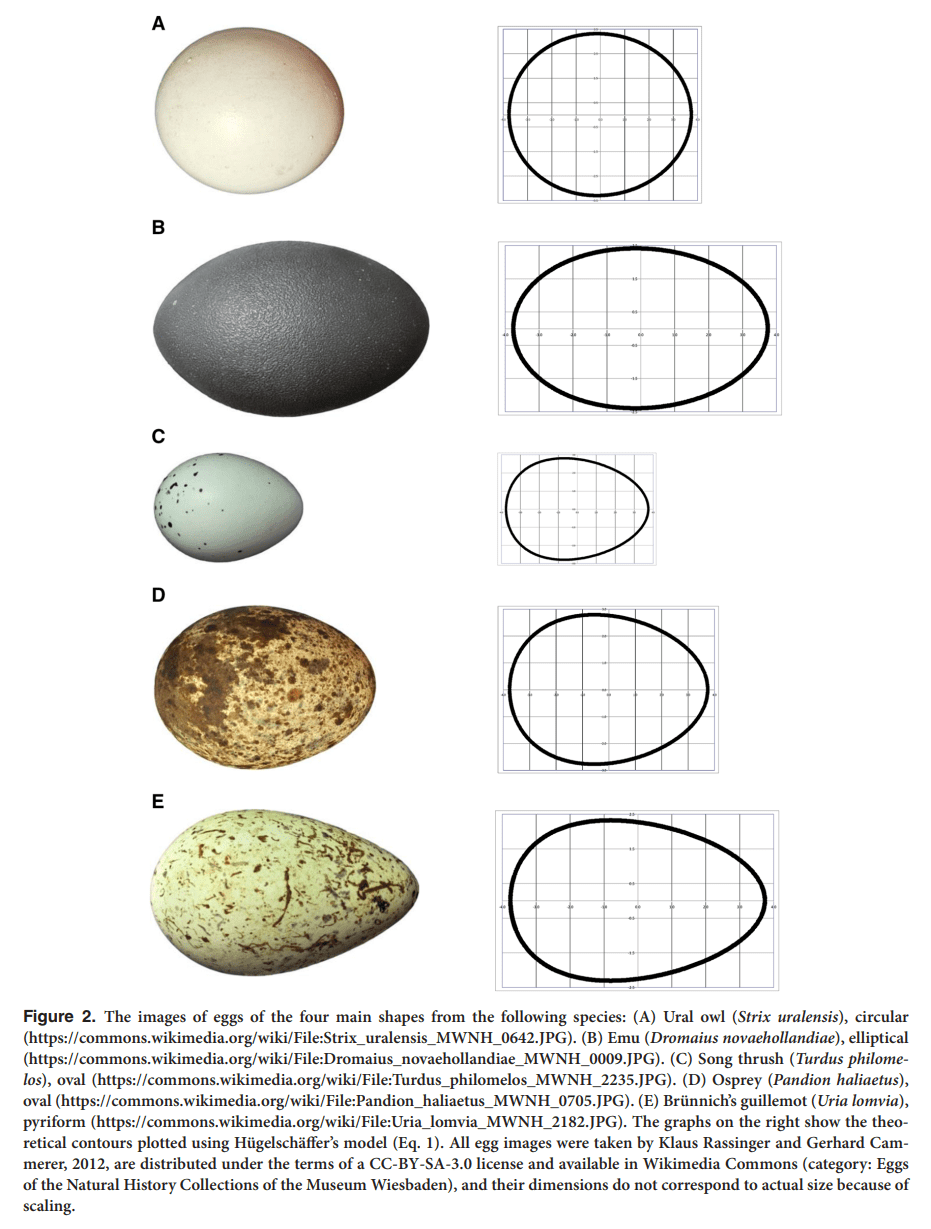
Researchers have discovered a universal mathematical formula that can describe any bird’s egg existing in nature — a significant step in understanding not only the egg shape itself, but also how and why it evolved, thus making widespread biological and technological applications possible.
Credit: University of Kent
The egg, as one of the most traditional food products, has long attracted the attention of mathematicians, engineers, and biologists from an analytical point of view. As a main parameter in oomorphology, the shape of a bird’s egg has, to date, escaped a universally applicable mathematical formulation. Analysis of all egg shapes can be done using four geometric figures: sphere, ellipsoid, ovoid, and pyriform (conical or pear-shaped). The first three have a clear mathematical definition, each derived from the expression of the previous, but a formula for the pyriform profile has yet to be derived. To rectify this, the researchers have introduced an additional function into the ovoid formula.
The subsequent mathematical model fits a completely novel geometric shape that can be characterized as the last stage in the evolution of the sphere—ellipsoid—Hügelschäffer’s ovoid transformation, and it is applicable to any egg geometry. The required measurements are the egg length, maximum breadth, and diameter at the terminus from the pointed end. This mathematical analysis and description represents the sought-for universal formula and is a significant step in understanding not only the egg shape itself, but also how and why it evolved, thus making widespread biological and technological applications theoretically possible.
Source (University of Kent. “A universal equation for the shape of an egg.” ScienceDaily. ScienceDaily, 31 August 2021.)
Original paper: Narushin, V.G., Romanov, M.N. and Griffin, D.K., 2021. Egg and math: introducing a universal formula for egg shape. Annals of the New York Academy of Sciences.
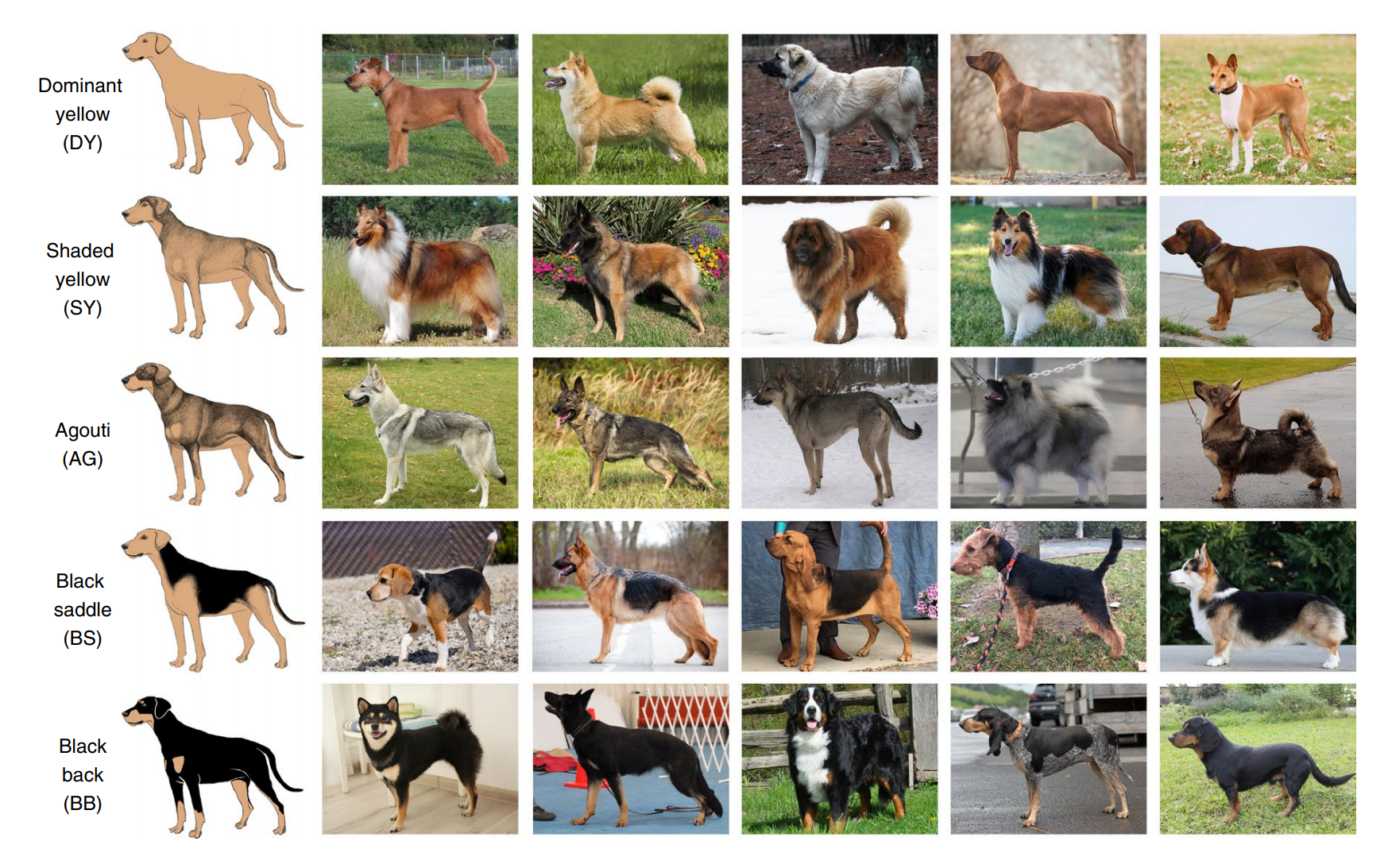
Scientists have unraveled the enigma of inheritance of coat color patterns in dogs. The researchers discovered that a genetic variant responsible for a very light coat in dogs and wolves originated more than two million years ago in a now extinct relative of the modern wolf.
Credit: University of Bern
The Institute of Genetics of the University of Bern has worked on understanding dog colour patterns and discovered that the gene responsible for a very light coat in wolves originated more than 2 million years ago which is now extinct. Wolves and dogs can make two different types of pigment, the black one, called eumelanin and the yellow, pheomelanin. A precisely regulated production of these two pigments at the right time and at the right place on the body gives rise to very different coat colour patterns. Prior to the study, four different patterns had been recognized in dogs and several genetic variants had been theorized which cause these patterns. During the formation of coat color, the so-called agouti signaling protein represents the body’s main switch for the production of yellow pheomelanin. If the agouti signaling protein is present, the pigment producing cells will synthesize yellow pheomelanin. If no agouti signaling protein is present, black eumelanin will be formed.
For the first time, the researchers characterized these two promoters in detail, in hundreds of dogs. They discovered two variants of the ventral promoter. One of the variants conveys the production of normal amounts of agouti signaling protein. The other variant has higher activity and causes the production of an increased amount of agouti signaling protein. The researchers even identified three different variants of the hair cycle-specific promoter. Starting with these variants at the individual promoters, the researchers identified a total of five different combinations, which cause different coat colour patterns in dogs.
Source (University of Bern. “Genetic enigma solved: Inheritance of coat color patterns in dogs.” ScienceDaily. ScienceDaily, 12 August 2021.)
Original paper: Bannasch, D.L., Kaelin, C.B., Letko, A., Loechel, R., Hug, P., Jagannathan, V., Henkel, J., Roosje, P., Hytönen, M.K., Lohi, H. and Arumilli, M., 2021. Dog colour patterns explained by modular promoters of ancient canid origin. Nature ecology & evolution, pp.1-9.