ENG: Researchers from the University of Bath, together with collaborators from the University of Chicago and the Paris Institute of Astrophysics, have used advanced simulations to investigate how the first stars and galaxies formed and enriched the early Universe with chemical elements. The work is part of the international MEGATRON project, which began in 2023 and is scheduled to continue until 2030. Four studies published in the Open Journal of Astrophysics provide the project’s first major set of results and aim to connect observations of early galaxies from the James Webb Space Telescope with the chemical signatures preserved in ancient stars in and around the Milky Way.
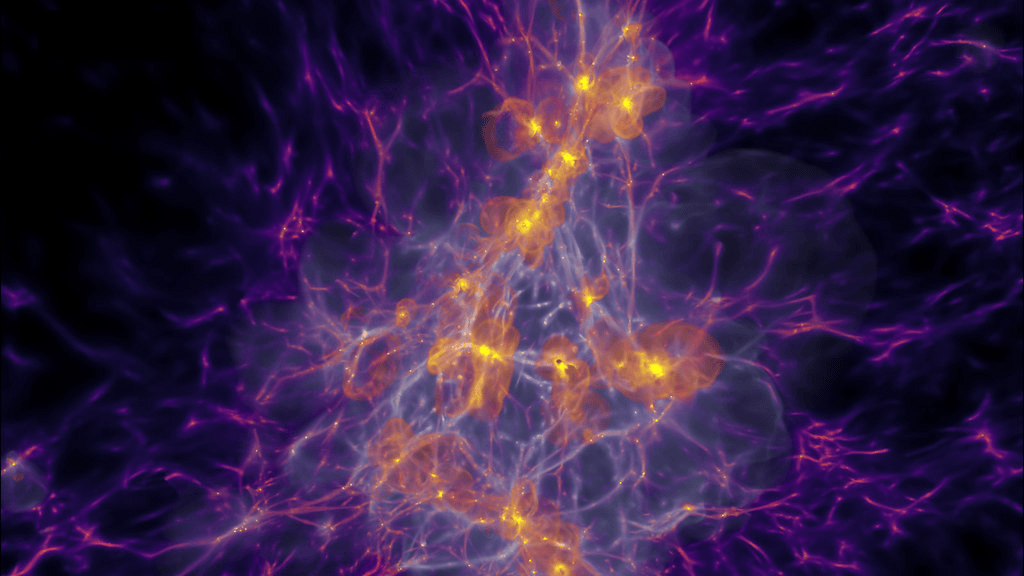
The simulations follow the evolution of a young galaxy that eventually develops into a system with a mass similar to that of the Milky Way. They begin with pristine gas containing no heavy elements and model the formation of the first stars, the radiation they produce, their supernova explosions and the dispersal of newly created elements into later generations of stars. The models simultaneously track gas dynamics, radiation transport and changes in chemical composition at very high resolution. This allows researchers to study how interactions between starlight, gas and chemical enrichment shaped the earliest galaxies and their surroundings.
The results indicate that simplified models can underestimate the effects of stellar radiation and complex chemical processes on gas around young galaxies. By resolving smaller-scale structures, the MEGATRON simulations can produce more accurate predictions for comparison with JWST observations and with the chemical composition of ancient stars. The team is now developing a new generation of simulations supported by 40 million processor hours on UK national supercomputers. These simulations will use higher resolution and more complete physical models to test competing theories about the first stars and the origin of the chemical elements found throughout the Universe today.
RO: Cercetători de la Universitatea din Bath, împreună cu colaboratori de la Universitatea din Chicago și Institutul de Astrofizică din Paris, au folosit simulări avansate pentru a studia modul în care s-au format primele stele și galaxii și cum au îmbogățit Universul timpuriu cu elemente chimice. Studiile fac parte din proiectul internațional MEGATRON, început în 2023 și programat să continue până în 2030. Patru lucrări publicate în Open Journal of Astrophysics reprezintă primul set important de rezultate ale proiectului și încearcă să stabilească o legătură între observațiile galaxiilor timpurii realizate cu Telescopul Spațial James Webb și semnăturile chimice păstrate în stelele foarte vechi din Calea Lactee și din vecinătatea acesteia.
Simulările urmăresc evoluția unei galaxii tinere care, în timp, ajunge la o masă comparabilă cu cea a Căii Lactee. Ele pornesc de la un gaz primordial, fără elemente grele, și modelează formarea primelor stele, radiația emisă de acestea, exploziile de supernovă și răspândirea elementelor nou formate către generațiile următoare de stele. Modelele urmăresc simultan dinamica gazului, propagarea radiației și modificările compoziției chimice, la o rezoluție foarte ridicată. Astfel, cercetătorii pot analiza mai precis modul în care lumina stelelor, gazul și procesele de îmbogățire chimică au influențat primele galaxii și mediul din jurul lor.
Rezultatele arată că modelele simplificate pot subestima efectele radiației stelare și ale proceselor chimice complexe asupra gazului din jurul galaxiilor tinere. Prin surprinderea unor structuri la scară mai mică, simulările MEGATRON pot oferi predicții mai precise pentru comparația cu observațiile realizate de Telescopul Spațial James Webb și cu compoziția chimică a stelelor foarte vechi. Echipa lucrează deja la o nouă generație de simulări, susținută de 40 de milioane de ore de procesare pe supercalculatoarele naționale ale Regatului Unit. Aceste simulări vor avea o rezoluție mai mare și modele fizice mai complete, pentru a testa diferite ipoteze despre primele stele și despre originea elementelor chimice prezente astăzi în Univers.
Source (University of Bath, “New simulations connect the first stars to cosmic fingerprints still visible today”, 30.09.2026)
Paper: Rey, Martin, Harley Katz, Corentin Cadiou, Mahsa Sanati, Oscar Agertz, Jeremy Blaizot, Alex J. Cameron, et al. 2026. “MEGATRON: How the First Stars Can Create an Iron Metallicity Plateau in the Smallest Dwarf Galaxies.” The Open Journal of Astrophysics 9 (September). https://doi.org/10.33232/001c.169605.
