ENG: At the scale of a bacterium, water is not a light, easy medium but a thick and resistant world, almost like tar, so an early single-celled organism that needed food had to solve the problem of movement before it could search, escape, or survive. Over immense periods of evolution, bacteria developed the flagellar motor, a tiny molecular machine that spins a tail-like flagellum hundreds of times per second and allows the cell to move through water many times its own length in a single second. When the motor turns in one direction, the bacterium swims forward, and when it reverses, the cell tumbles, changes orientation, and begins moving again along a new path.
Recent research has made this mechanism much clearer by showing how the parts of the motor work together at the molecular level. At the base of the motor is a rotating structure called the C ring, while around it sit smaller protein complexes called stators, which act like tiny cogwheels pressing against the larger ring. Protons flow into the cell through these stators because of differences in charge and concentration across the membrane, and as they pass through, they generate torque that turns the stators, then the C ring, and finally the flagellum itself. In this way, a flow of charged particles becomes mechanical motion.
This proton flow also reveals a deeper principle behind life. Cells constantly pump protons out so that they can flow back in, creating a stored imbalance known as the proton motive force, which powers many essential cellular processes. If that imbalance collapses, the machinery of the cell loses its driving force, the flagellar motor stops, and the bacterium is once again unable to move. The flagellar motor therefore shows how life uses physics at the smallest scale, maintaining imbalance, guiding flow, and transforming molecular movement into purposeful motion.
RO: La scara unei bacterii, apa nu este un mediu ușor de străbătut, ci o lume densă și rezistentă, aproape ca smoala, așa că un organism unicelular timpuriu, aflat în căutarea hranei, trebuia mai întâi să rezolve problema deplasării pentru a putea căuta, evita condițiile nefavorabile și supraviețui. De-a lungul unor perioade uriașe de evoluție, bacteriile au dezvoltat motorul flagelar, o mașinărie moleculară minusculă care rotește un flagel, asemănător unei cozi, de sute de ori pe secundă și permite celulei să înainteze prin apă pe distanțe de multe ori mai mari decât propria lungime. Când motorul se rotește într-un sens, bacteria înoată înainte, iar când își inversează sensul, celula se răsucește, își schimbă orientarea și pornește din nou pe o altă direcție.
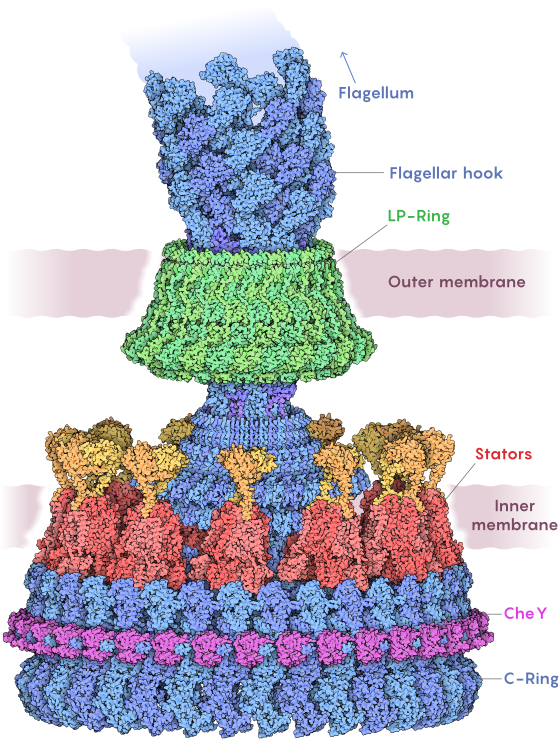
Cercetările recente au clarificat mult mai bine acest mecanism, arătând cum lucrează împreună componentele motorului la nivel molecular. La baza motorului se află o structură rotitoare numită inelul C, iar în jurul ei se găsesc complexe proteice mai mici, numite statori, care acționează ca niște rotițe dințate apăsate pe inelul mai mare. Protonii intră în celulă prin acești statori datorită diferențelor de sarcină electrică și de concentrație de o parte și de alta a membranei, iar trecerea lor produce o forță de rotație care pune în mișcare statorii, apoi inelul C și, în cele din urmă, flagelul. Astfel, un flux de particule încărcate electric se transformă în mișcare mecanică.
Acest flux de protoni arată și un principiu mai profund al vieții. Celulele pompează permanent protoni în afară pentru ca aceștia să poată intra din nou, creând un dezechilibru controlat, numit forță proton-motoare, care alimentează multe procese esențiale din celulă. Dacă acest dezechilibru dispare, mecanismele celulei își pierd sursa de energie, motorul flagelar se oprește, iar bacteria nu se mai poate deplasa. Motorul flagelar arată, astfel, cum viața folosește fizica la cea mai mică scară: menține un dezechilibru, dirijează un flux și transformă mișcarea moleculară în deplasare cu scop.
Source (Natalie Wolchover, Quanta Magazine, “What Physical ‘Life Force’ Turns Biology’s Wheels?”, 20.04.2026)
Paper: Singh, P.K., Sharma, P., Afanzar, O., Goldfarb, M.H., Maklashina, E., Eisenbach, M., Cecchini, G. and Iverson, T.M., 2024. CryoEM structures reveal how the bacterial flagellum rotates and switches direction. Nature Microbiology, 9(5), pp.1271-1281.
