ENG: Stars are born within vast cosmic nurseries, where dense clouds of gas and dust collapse under gravity to form stellar embryos. In our Milky Way, these molecular clouds typically exhibit an elongated filamentary structure, guiding the formation of stars much like cosmic highways channeling matter. However, a recent study led by researchers from Kyushu University and Osaka Metropolitan University challenges the idea that stars have always formed in this structured manner. By observing the Small Magellanic Cloud (SMC), a dwarf galaxy with a chemical composition similar to the early universe, scientists discovered that not all molecular clouds take on a filamentary form. Some appear “fluffy,” reshaping our understanding of star formation across cosmic history.
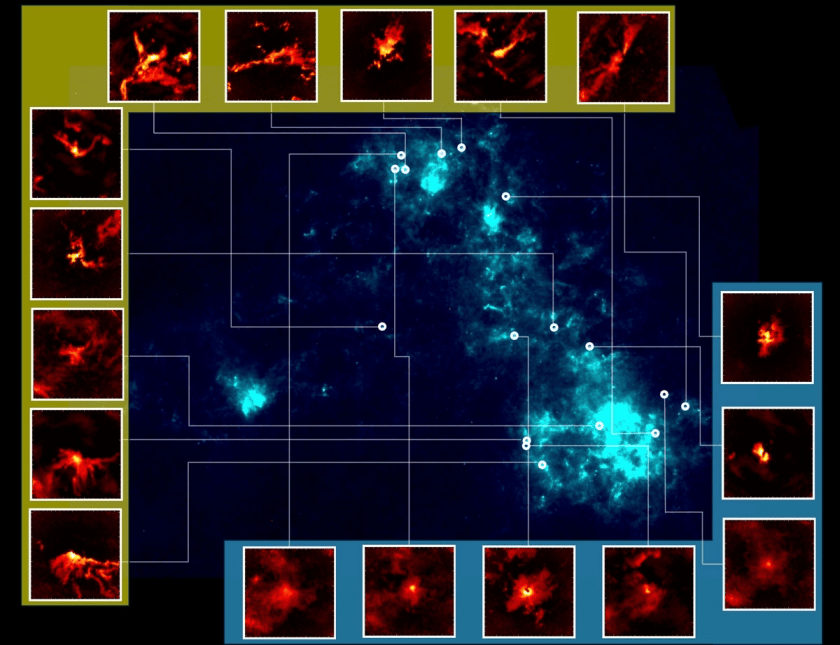
Using high-resolution data from the ALMA radio telescope, researchers analyzed 17 molecular clouds in the SMC, uncovering a striking difference in their structures. About 60% of the observed clouds retained the familiar filamentary shape, while 40% exhibited a more diffuse, irregular structure. The study suggests that these differences arise from temperature changes over time. Initially, molecular clouds are hot and filamentary due to cloud collisions, but as temperatures drop, turbulence increases, breaking down the structure into a more chaotic, fluffy form. This distinction is crucial, as filamentary clouds are more likely to fragment and form stars similar to our Sun, while fluffy clouds may struggle to support planetary system formation.
These findings emphasize the importance of environmental factors, such as the presence of heavy elements, in determining the structure of star-forming clouds. In the early universe, where elements beyond hydrogen and helium were scarce, fluffy clouds may have been more common, leading to a different pattern of star formation. By comparing these results with molecular clouds in the Milky Way and other metal-rich environments, scientists hope to uncover deeper insights into how stars and planetary systems have evolved over billions of years, ultimately shaping the galaxies we see today.
RO: Stelele se nasc în vaste pepiniere cosmice, unde norii denși de gaz și praf se prăbușesc sub acțiunea gravitației, formând embrioni stelari. În Calea Lactee, acești nori moleculari prezintă de obicei o structură filamentoasă alungită, ghidând formarea stelelor asemenea unor autostrăzi cosmice care canalizează materia. Totuși, un studiu recent realizat de cercetători de la Universitatea Kyushu și Universitatea Metropolitană din Osaka pune sub semnul întrebării ideea că stelele s-au format întotdeauna în acest mod structurat. Observând Norul Mic al lui Magellan (SMC), o galaxie pitică cu o compoziție chimică similară universului timpuriu, oamenii de știință au descoperit că nu toți norii moleculari au o formă filamentoasă. Unii par a fi „pufoși”, remodelând astfel înțelegerea noastră asupra formării stelelor de-a lungul istoriei cosmice.
Folosind date de înaltă rezoluție de la radiotelescopul ALMA, cercetătorii au analizat 17 nori moleculari din SMC, descoperind o diferență izbitoare în structurile acestora. Aproximativ 60% dintre norii observați au păstrat forma filamentoasă cunoscută, în timp ce 40% au prezentat o structură mai difuză și neregulată. Studiul sugerează că aceste diferențe apar din cauza schimbărilor de temperatură în timp. Inițial, norii moleculari sunt fierbinți și filamentoși din cauza coliziunilor dintre nori, dar pe măsură ce temperatura scade, turbulența crește, distrugând structura și transformând-o într-o formă mai haotică și pufoasă. Această distincție este esențială, deoarece norii filamentoși sunt mai predispuși să se fragmenteze și să formeze stele similare Soarelui nostru, în timp ce norii pufoși pot avea dificultăți în susținerea formării sistemelor planetare.
Aceste descoperiri subliniază importanța factorilor de mediu, cum ar fi prezența elementelor grele, în determinarea structurii norilor care formează stele. În universul timpuriu, unde elementele mai grele decât hidrogenul și heliul erau rare, norii pufoși ar fi putut fi mai comuni, ducând la un model diferit de formare stelară. Comparând aceste rezultate cu norii moleculari din Calea Lactee și din alte medii bogate în metale, oamenii de știință speră să obțină o înțelegere mai profundă a modului în care stelele și sistemele planetare au evoluat de-a lungul miliardelor de ani, modelând în cele din urmă galaxiile pe care le observăm astăzi.
Source (Kyushu University, “In ancient stellar nurseries, some stars are born of fluffy clouds”, 20.02.2025)
Paper: Kazuki Tokuda, Yuri Kunitoshi, Sarolta Zahorecz, Kei E. I. Tanaka, Itsuki Murakoso, Naoto Harada, Masato I. N. Kobayashi, Tsuyoshi Inoue, Marta Sewiło, Ayu Konishi, Takashi Shimonishi, Yichen Zhang, Yasuo Fukui, Akiko Kawamura, Toshikazu Onishi, Masahiro N. Machida. ALMA 0.1 pc View of Molecular Clouds Associated with High-mass Protostellar Systems in the Small Magellanic Cloud: Are Low-metallicity Clouds Filamentary or Not? The Astrophysical Journal, 2025; 980 (2): 269 DOI: 10.3847/1538-4357/ada5f8
