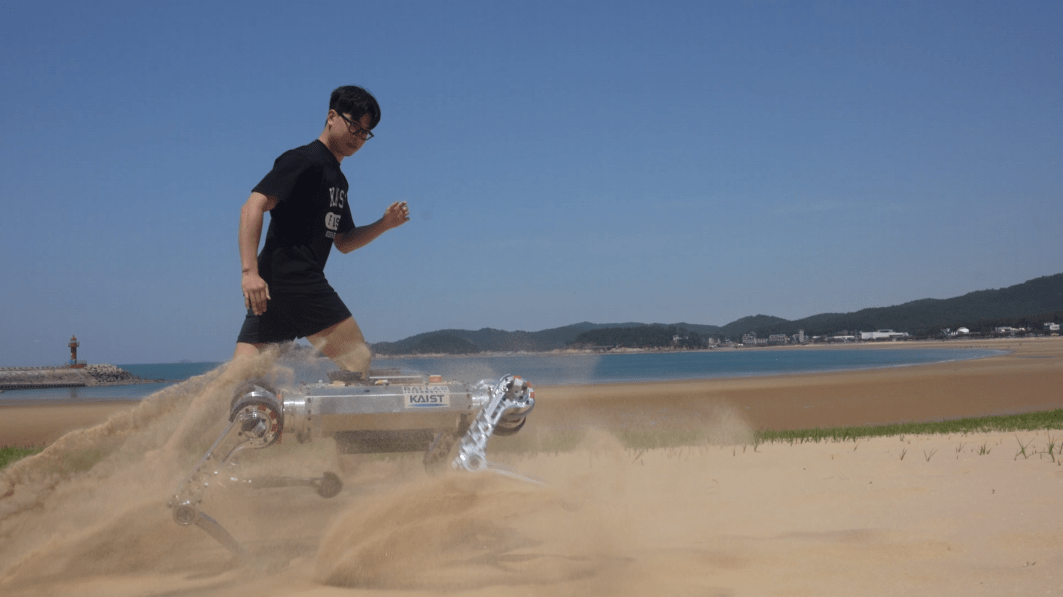
ENG: KAIST (President Kwang Hyung Lee) announced on the 25th January that a research team led by Professor Jemin Hwangbo of the Department of Mechanical Engineering developed a quadrupedal robot control technology that can walk robustly with agility even in deformable terrain such as sandy beach.
ENG: Enhancing the virtual experience with the touch sensation has become a hot topic, but today’s haptic devices remain typically bulky and tangled with wires. A team led by the City University of Hong Kong (CityU) researchers recently developed an advanced wireless haptic interface system, called WeTac, worn on the hand, which has soft, ultrathin soft features, and collects personalised tactile sensation data to provide a vivid touch experience in the metaverse.
ENG: Researchers have been trying to design cyborg insects—part insect, part machine—to help inspect hazardous areas or monitor the environment. However, for the use of cyborg insects to be practical, handlers must be able to control them remotely for long periods of time. This requires wireless control of their leg segments, powered by a tiny rechargeable battery. Keeping the battery adequately charged is fundamental—nobody wants a suddenly out-of-control team of cyborg cockroaches roaming around. While it’s possible to build docking stations for recharging the battery, the need to return and recharge could disrupt time-sensitive missions. Therefore, the best solution is to include an on-board solar cell that can continuously ensure that the battery stays charged.
ENG: Scientists and engineers are constantly developing new materials with unique properties that can be used for 3D printing, but figuring out how to print with these materials can be a complex, costly conundrum. Often, an expert operator must use manual trial-and-error — possibly making thousands of prints — to determine ideal parameters that consistently print a new material effectively. These parameters include printing speed and how much material the printer deposits.