Bacteria-Based Transistors Open New Paths for Biological Computing

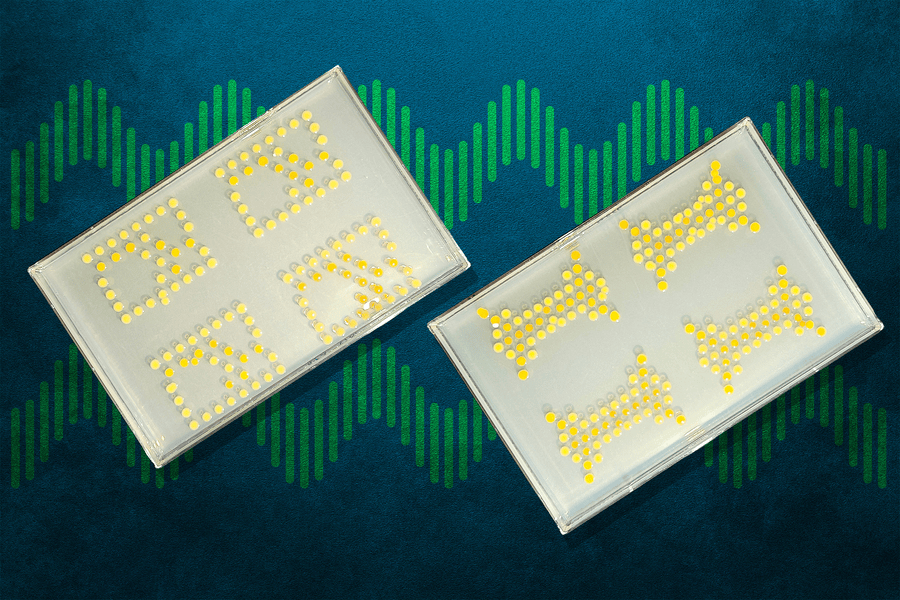
ENG: MIT researchers have developed engineered bacteria that can function like transistors, allowing them to build “living circuit boards” capable of processing information. Instead of controlling electrical current, these biological transistors regulate the movement of signaling molecules between bacterial colonies. The team created two types of bacterial transistors and three relay strains that transmit signals between them, providing a modular set of components that can be combined to perform different computational tasks.
Credit: MIT
Read More

Australia’s First Wind Trees Bring Clean Energy to Urban Spaces

ENG: Australia’s first “Wind Trees” are bringing renewable energy into an urban setting in a striking new way. Installed along Connolly Drive in Clarkson, Western Australia, the two nine-metre-high structures are designed to resemble stylized metal trees. Instead of ordinary leaves, each tree carries 36 small wind turbines known as Aeroleaves, which generate electricity as they spin in the breeze. The technology is designed to work with wind coming from different directions and can begin producing energy even at relatively low wind speeds.

Read More

Tailored Vibrations Could Help Reduce Turbulence in Aircraft

ENG: Researchers at the University of Colorado Boulder are developing a new approach to aerodynamic flow control that uses engineered microscopic vibrations beneath an aircraft’s surface. Led by Mahmoud I. Hussein, the work focuses on phononic subsurfaces (PSubs), specially designed materials that interact passively with airflow without changing the external shape of a wing or fuselage. By controlling tiny internal vibrations known as phonons, these subsurfaces could delay the transition from laminar to turbulent flow, potentially reducing aerodynamic drag and improving fuel efficiency in commercial and high-speed aircraft.

Credit: University of Colorado Boulder
Read More

Same-Day 3D-Printed Dental Crowns Could Soon Be a Reality

ENG: Researchers at the University of Texas at Dallas have developed a new method that could make same-day, 3D-printed zirconia dental restorations possible. Zirconia is widely used for permanent crowns, bridges, and veneers because of its strength and durability, but traditional 3D-printing methods require a lengthy debinding process that can take 20 to 100 hours. The UT Dallas team reduced this step to less than 30 minutes by combining improved heat transfer, porous graphite felt, and a vacuum system that safely removes gases released from the printed material.

Read More