ENG: Flexible, stretchable organic light-emitting diodes (OLEDs) are increasingly important for mobile displays and for wearable electronics that could conform to the body and show changes in temperature, blood flow, or pressure in real time. A key challenge has been keeping OLED brightness stable after repeated bending and stretching, because conventional transparent conductor layers can crack over time or reduce charge transport when combined with stretchable polymers. Researchers from Drexel University and Seoul National University report a device design that targets this durability problem by rethinking both the light-emitting layer and the transparent electrodes.
Read MoreCategory: Engineering
Observing the Quantum Metric in Oxide Interfaces
ENG: A research team from the University of Geneva reports experimental evidence for a “hidden” geometry inside certain quantum materials. The idea is called the quantum metric and it describes how the quantum states available to electrons are arranged and “curved” in an abstract space. Even though this space is not ordinary physical space, its curvature can still affect what happens in the lab, because electrons follow paths that depend on the structure of their quantum states. In simple terms, if that quantum space is curved, electron motion can be subtly redirected, somewhat like how gravity changes the path of light. For about two decades the quantum metric was mostly treated as a theoretical concept, because it was difficult to isolate a clear experimental signature of its effects.
Read MoreHunting Instabilities in Fluid Dynamics
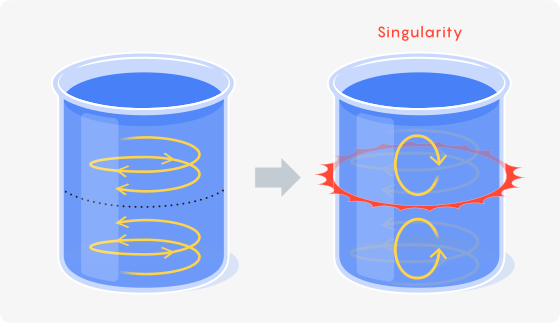
ENG: For nearly two centuries, the Navier–Stokes equations have been the gold standard for describing how fluids move, from ocean currents to the airflow over a wing. But mathematicians have long suspected there may be rare situations where this elegant theory “glitches.” In those extreme cases, the equations might predict something physically nonsensical: a whirlpool that accelerates without limit, or a quantity like vorticity shooting to infinity in finite time. That kind of mathematical breakdown is called a singularity or blowup, and proving whether it can (or cannot) happen for three-dimensional Navier–Stokes is so hard it’s one of the Clay Millennium Prize Problems, with $1 million on the line.
Guided Representation Alignment for Training Neural Networks
ENG: The methodology proposed by researchers at MIT and Computer Science and Artificial Intelligence Laboratory is based on aligning internal representations between two neural networks during training. Instead of training a target network independently from random initialization, the approach introduces a guide network whose role is to shape the learning dynamics of the target. During an initial guidance phase, the target network is encouraged to produce intermediate activations that are similar to those of the guide network when both are exposed to the same inputs. This alignment is enforced through an auxiliary loss that measures representational similarity at multiple layers, effectively constraining the target network to explore more favorable regions of the parameter space.
Read More