Fiber Like Photonic Chips with Record Low Visible Light Loss

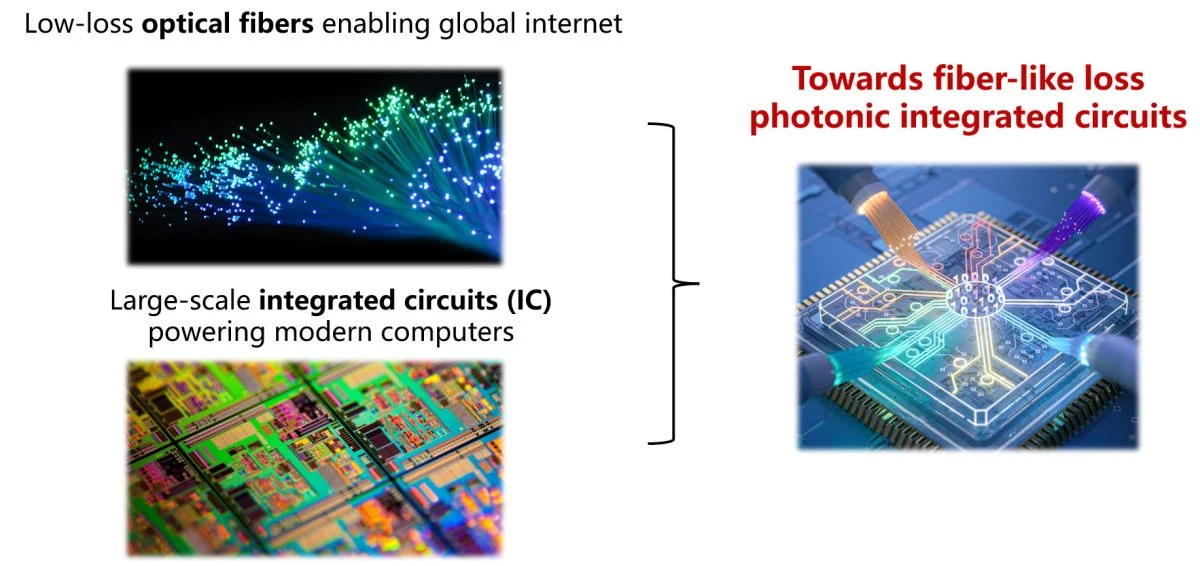
ENG: Caltech researchers have developed a photonic chip platform that allows light to propagate through on chip waveguides with extremely low loss, approaching optical fiber like performance even at visible wavelengths. Achieving such low loss on a chip is important because it preserves optical coherence, which improves the stability of lasers and supports photonic systems for precision sensing, timing, and quantum technologies.

Credit: Hao-Jing Chen
Read More

Creating Skyrmions by Twisting Atomically Thin Magnetic Layers

ENG: As the world creates more data every day, scientists are looking for ways to store information in much smaller spaces without losing reliability. Researchers at the University of Stuttgart report a promising step in that direction. By introducing a very small twist between ultra thin layers of a magnetic material called chromium iodide, they produced tiny, stable magnetic swirls known as skyrmions. These structures are extremely robust, which is why they are so interesting as potential building blocks for future high density data storage.

Credit: University of Stuttgart / Ludmilla Parsyak
Read More

High Efficiency Stretchable OLED Displays

ENG: Flexible, stretchable organic light-emitting diodes (OLEDs) are increasingly important for mobile displays and for wearable electronics that could conform to the body and show changes in temperature, blood flow, or pressure in real time. A key challenge has been keeping OLED brightness stable after repeated bending and stretching, because conventional transparent conductor layers can crack over time or reduce charge transport when combined with stretchable polymers. Researchers from Drexel University and Seoul National University report a device design that targets this durability problem by rethinking both the light-emitting layer and the transparent electrodes.

Credit: Drexel University
Read More

Observing the Quantum Metric in Oxide Interfaces

ENG: A research team from the University of Geneva reports experimental evidence for a “hidden” geometry inside certain quantum materials. The idea is called the quantum metric and it describes how the quantum states available to electrons are arranged and “curved” in an abstract space. Even though this space is not ordinary physical space, its curvature can still affect what happens in the lab, because electrons follow paths that depend on the structure of their quantum states. In simple terms, if that quantum space is curved, electron motion can be subtly redirected, somewhat like how gravity changes the path of light. For about two decades the quantum metric was mostly treated as a theoretical concept, because it was difficult to isolate a clear experimental signature of its effects.

Credit: Xavier Ravinet – UNIGE
Read More